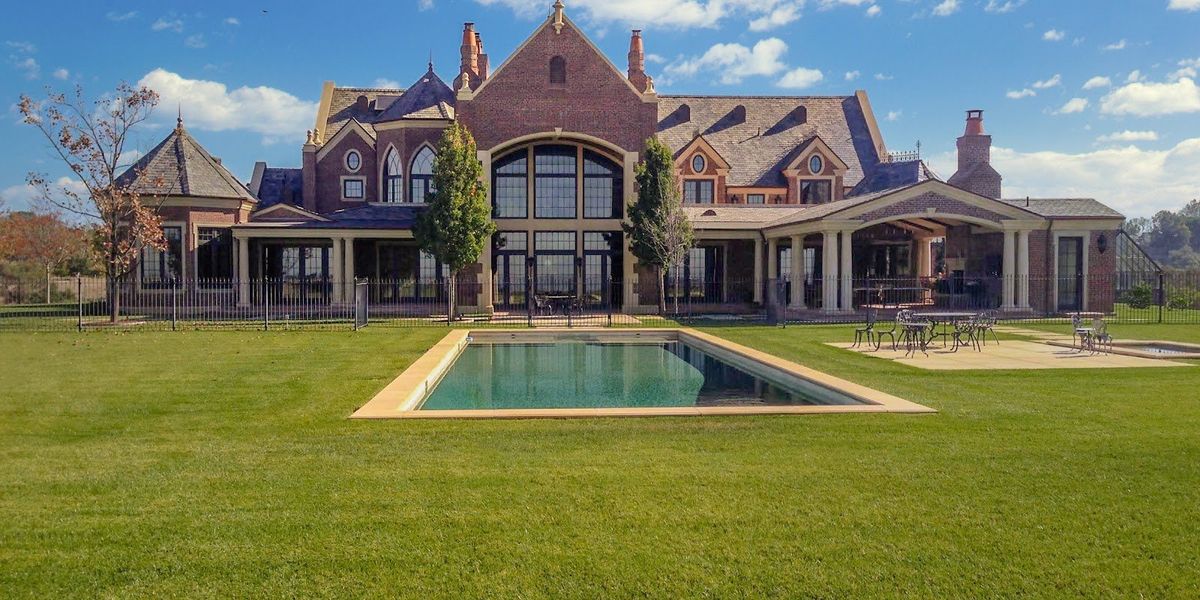
There's a line that gets thrown around in luxury construction: 'we're not just builders, we're partners in design.' Most of the time, it's marketing language. Sometimes, though, it's a job description.
At Roderick Builders, the distinction between builder and design collaborator dissolved a long time ago. When you've spent two decades working alongside architects like Thomas Juul-Hansen, Paul McClean, and Fabio Rigo de Righi, you stop thinking in terms of blueprints and start thinking in terms of intent. What is this home supposed to feel like? What's the light doing at 4 PM in November? How does the stone meet the glass?
The Builder Who Reads the Architect's Mind
Most builders receive a set of construction documents and execute them. A design-led builder reads between the lines. On the Getty House in Bel Air — a collaboration with Thomas Juul-Hansen — the architectural drawings called for 20-foot ceilings and walls of glass framing canyon-to-ocean views. What the drawings didn't specify was how to achieve that sense of weightlessness while engineering a structure that meets California seismic requirements. That's the conversation that happens at 7 AM on the job site, not in a conference room.
The same principle applied at Benloch Lot 134, where Trapper worked with the design team to translate Scandinavian-inspired minimalism into construction reality. Every board-and-batten joint, every stone coursing decision, every concealed mechanical system — these are the hundreds of micro-decisions that separate a home that looks good in renderings from one that feels inevitable in person.
Material Intelligence
A design-led builder develops what we call material intelligence — an intuitive understanding of how materials behave over time, in specific climates, under specific conditions. In Park City, where temperatures swing 100 degrees between seasons and UV exposure at 7,000 feet accelerates weathering, material selection isn't an aesthetic choice. It's an engineering one.
This is why we maintain direct relationships with suppliers like MLD Salt Lake for fixtures and hardware, and why we test material samples on-site before committing to full installations. The Italian porcelain that looks perfect in a showroom might read completely differently under the alpine light of the Wasatch Back.
Construction as Problem-Solving
Every luxury home presents problems that don't exist on paper. The Thrasher Avenue Estate in the Bird Streets — featured in the Los Angeles Times — required building a 5,000-square-foot rooftop deck on a hillside lot. The Stradella project in Bel Air demanded integrating a home theater and wellness suite into a structure where every square foot had already been accounted for.
These aren't exceptions. They're Tuesday. The difference between a builder who panics and a design-led builder is that the latter treats constraints as creative fuel. A smaller lot doesn't mean a smaller vision — it means a more considered one.
The Utah-California Advantage
Operating across two distinct markets — Los Angeles and Park City — gives us something most regional builders lack: cross-pollination. The entertainment-industry precision that California clients expect has raised the bar for our Utah work. The mountain-environment material expertise we've developed in Park City has informed how we approach durability and longevity in our coastal builds.
Travis leads our California projects, bringing that hands-on intensity to every build from Bel Air to the Bird Streets. Trapper oversees the business and the Utah portfolio, where communities like Victory Ranch, Promontory, and Benloch demand a builder who understands both high design and high altitude.
Choosing a Builder Who Thinks Like a Designer
If you're interviewing builders for a luxury custom home, ask them about a time they pushed back on an architectural detail — not to cut costs, but to improve the outcome. Ask them about a material substitution they initiated. Ask them how they handle the gap between what a rendering promises and what physics allows.
The answers will tell you everything you need to know about whether you're hiring a contractor or a collaborator. At Roderick Builders, we've built our reputation on being the latter — and every project, from Icon Haus in Park City to the Getty House in Bel Air, is proof of what that distinction means in practice.
Frequently Asked Questions
What is a design-led builder?
A design-led builder integrates design thinking into every construction decision — from site orientation and material selection to detail execution and finish coordination. Unlike traditional builders who simply follow plans, Roderick Builders collaborates with architects and clients to enhance the design vision through construction expertise.
How is a design-build approach different from traditional construction?
In traditional construction, the architect designs and the builder executes — often creating conflicts. Design-build integrates both under one team, eliminating communication gaps, reducing change orders, and ensuring the built result matches the designed vision. Roderick Builders' design-build process typically saves 15-20% of construction time.
Why does design matter in custom home building?
Design determines how a home feels, functions, and appreciates. A well-designed home commands 20-30% more at resale than a poorly designed one of similar size and quality. Design encompasses spatial flow, natural light, proportions, material harmony, and connection to the landscape — not just aesthetics.
How does Roderick Builders work with architects?
We collaborate with top architects from the earliest design stages, providing constructibility input, cost feedback, and material expertise. This prevents the common scenario where beautiful designs become compromised during construction due to budget or technical constraints.
What is the benefit of having a builder involved early in the design process?
Early builder involvement catches design issues before they become expensive problems. We provide real-time cost estimates as designs evolve, identify structural efficiencies, and ensure material specifications are both beautiful and buildable in mountain conditions.